2026-07-23
Engineering Expertise Beyond Precision Machining
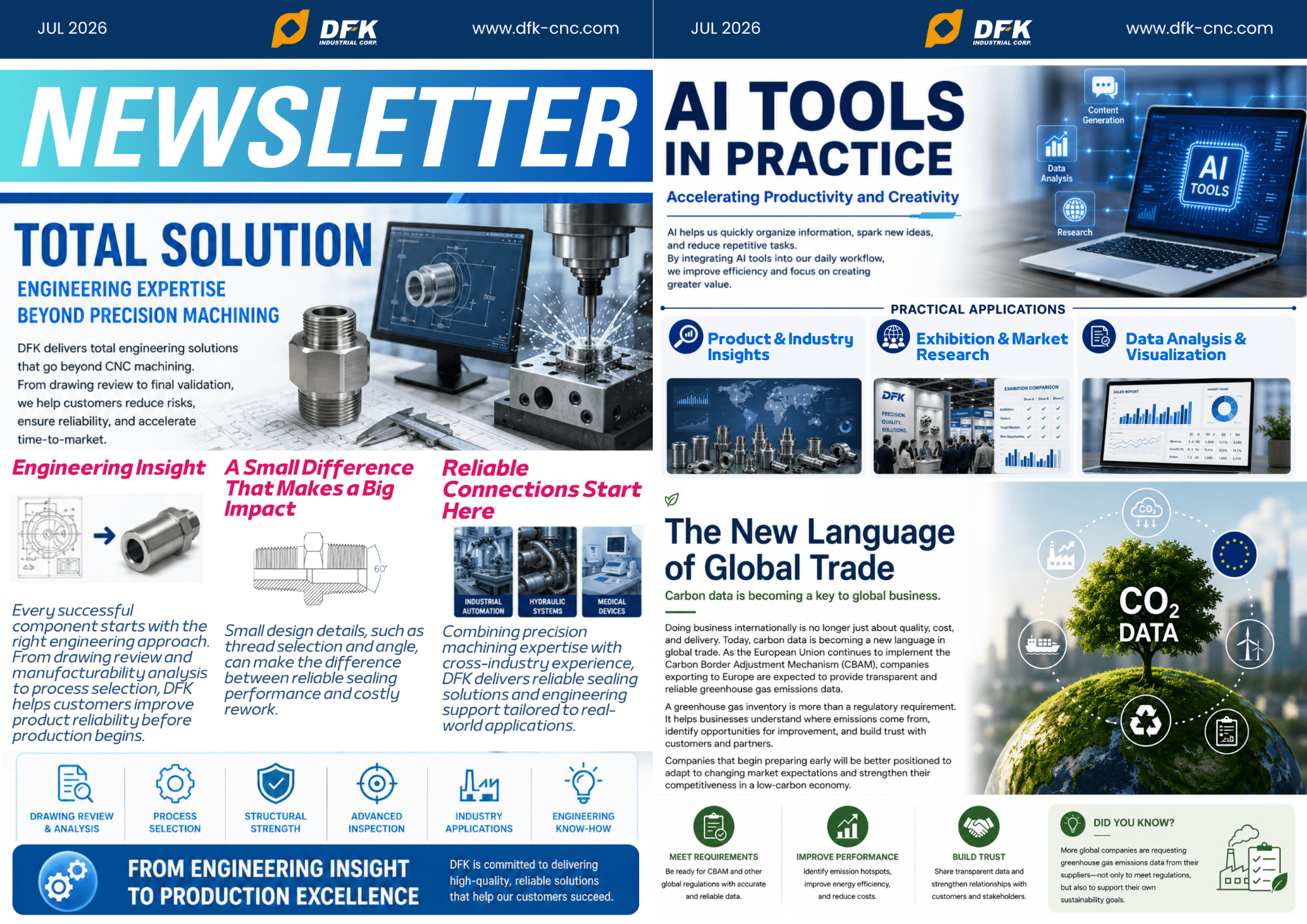
Precision machining is not only about producing a component according to a drawing. Before production begins, decisions involving manufacturability, machining methods, thread specifications, sealing surfaces, inspection requirements, and operating conditions can all affect the reliability of the finished part.
DFK Industrial Corp. provides CNC machining services supported by engineering review, manufacturing experience, inspection capabilities, and continuous process improvement. From the initial drawing review to production and quality verification, our team works with customers to identify potential concerns early and develop practical solutions for demanding industrial applications.
More Than CNC Machining: Engineering Support from Drawing to Production
Every successful machined component begins with a clear understanding of its function and application.
Before machining, DFK’s R&D engineering team reviews customer drawings, evaluates manufacturability, and considers the most suitable production method according to the component geometry, material, tolerance, functional requirements, and expected production volume.
This process helps identify issues that may affect machining efficiency, assembly, sealing performance, or long-term reliability. Addressing these details early can reduce unnecessary revisions and create a smoother transition from design to production.
DFK’s CNC machining capabilities include:
- CNC turning
- CNC milling
- Drilling
- Precision grinding
- Dimensional and surface inspection
- Assembly and validation testing
- Integrated manufacturing support
With manufacturing capabilities supporting both small-batch prototypes and volume production, DFK helps customers move from an initial design concept toward stable and repeatable manufacturing.
Engineering Insight: Small Design Details Can Make a Major Difference
Some of the most important engineering decisions involve details that may appear minor on a drawing. Thread standards and sealing surface geometry are two common examples.
When these specifications are not confirmed early, the resulting component may still meet its basic dimensional requirements but fail to perform correctly during assembly or operation.
Thread Selection Matters
PT and NPT threads may appear similar, but they follow different standards and should not be treated as interchangeable.
Selecting an incorrect thread specification can result in:
- Incompatible mating components
- Assembly difficulties
- Inadequate sealing
- Leakage under operating pressure
- Reduced system reliability
As part of its CNC machining service, DFK reviews relevant drawing details and confirms machining requirements before production. Verifying the thread standard, size, taper, and intended connection at an early stage helps reduce the risk of mismatched parts and supports more reliable assembly.
Sealing Surface Design Supports Reliable Connections
The sealing surface is another critical consideration for components used in fluid, pneumatic, hydraulic, or pressure-control systems.
Depending on the application, a component may require a flat face, chamfer face, or O-ring groove. Each design creates a different contact and sealing condition, so the appropriate geometry must be determined according to the mating component, sealing method, operating pressure, and functional requirements.
Accurate CNC machining of sealing surfaces can help:
- Reduce the risk of leakage
- Maintain pressure integrity
- Improve assembly consistency
- Protect sealing elements from improper contact
- Support longer component service life
DFK combines engineering interpretation with precision machining and inspection to manufacture components according to the required sealing design. Critical dimensions, profiles, and surface conditions can then be checked using suitable inspection equipment before delivery.
Inspection Connects Machining Accuracy with Functional Reliability
Machining a part is only one stage of the manufacturing process. The finished component must also be inspected to confirm that critical dimensions and functional features meet the specified requirements.
DFK uses a range of precision inspection equipment for dimensional measurement, profile verification, roundness and cylindricity measurement, surface roughness inspection, hardness testing, and other quality checks.
Available inspection resources include:
- 3D coordinate measuring machines
- Automatic image measurement systems
- Contour measuring equipment
- Roundness and cylindricity measuring equipment
- Surface roughness testers
- Digital height gauges
- Hardness testers
- Video optical comparators
By combining CNC machining expertise with systematic inspection, DFK can identify potential deviations during the manufacturing process rather than waiting until final assembly. This approach supports consistent quality, stable production, and reliable component performance.
For projects that require more than individual machined parts, DFK also provides assembly and validation testing to help verify strength, durability, sealing, and functionality according to project requirements.
Preparing for a Low-Carbon Global Supply Chain
Quality, cost, and delivery remain important in international manufacturing, but customers are increasingly paying attention to another type of information: carbon emissions data.
As the European Union continues implementing the Carbon Border Adjustment Mechanism, commonly known as CBAM, companies participating in international supply chains may face growing expectations for transparent and reliable greenhouse gas emissions information.
DFK has begun advancing its carbon inventory and reduction planning as part of its broader ESG development. Establishing reliable carbon data can help a manufacturing company understand where emissions originate, identify opportunities to improve energy efficiency, and respond more effectively to future customer or regulatory requirements.
Early preparation can support several business objectives:
- Preparing for CBAM and other carbon-related requirements
- Identifying emission sources and improvement opportunities
- Improving energy and operational efficiency
- Providing greater transparency to customers and partners
- Strengthening competitiveness in international supply chains
For DFK, carbon management is not treated as a separate activity from manufacturing. It is part of building a more resilient and responsible CNC machining service for customers operating in global markets.
Using AI Tools to Improve Internal Efficiency
In addition to strengthening engineering and sustainability capabilities, DFK is also introducing artificial intelligence tools into internal learning and daily operations.
Tools such as ChatGPT and Gemini can assist employees in organizing complex information, exploring industry applications, comparing market information, and reducing repetitive administrative work.
Current learning and practical applications include:
- Product application and industry analysis
- Exhibition research and comparison
- Competitive and market analysis
- Information organization and summarization
- Data-assisted decision support
- Brand guideline development
- Converting design ideas or hand-drawn concepts into visual references
AI does not replace engineering knowledge, machining experience, or human judgment. Instead, it supports employees in processing information more efficiently, exploring ideas, and devoting more time to problem-solving and customer communication.
By combining digital tools with professional expertise, DFK continues to improve the way information is used throughout its engineering and manufacturing processes.
A CNC Machining Service Built Around the Complete Project
Customers looking for a CNC machining service often need more than a supplier capable of operating machining equipment. They need a partner who can understand drawings, recognize manufacturing risks, confirm important specifications, maintain production consistency, and verify finished components.
DFK brings these capabilities together through:
- Engineering and manufacturability review
- CNC turning, milling, drilling, and grinding
- Support from prototypes to volume production
- Precision inspection and quality control
- Assembly and validation testing
- Carbon-management preparation
- Continuous employee and digital-tool development
DFK can also coordinate integrated manufacturing services, including grinding, EDM, welding, assembly, and surface treatment, according to individual project requirements.
From a small thread specification to the overall manufacturing and inspection process, every detail can influence the success of a component.
DFK Industrial Corp. is committed to providing CNC machining services that connect engineering insight, precision production, quality verification, and long-term manufacturing value.
Looking for a CNC machining partner for your next project?
Discuss your drawings, application requirements, and production needs with DFK.